
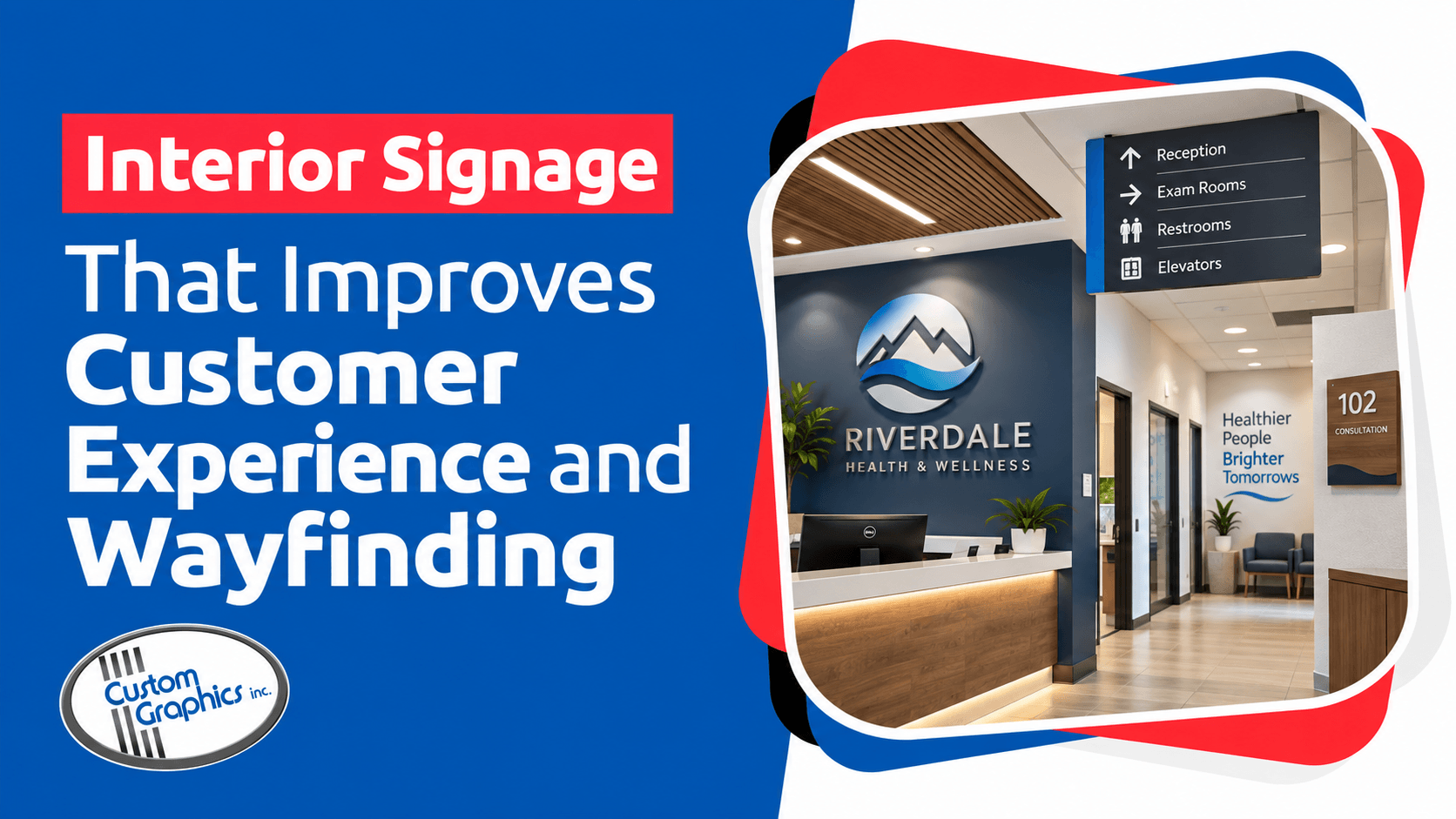
Interior signage plays an important role in shaping how customers experience a space. While exterior signage helps attract attention and bring people through the door, the signs and graphics inside determine what happens next.
Customers should be able to understand where they are, where they need to go, and what your business represents without having to stop and ask for help. Thoughtfully designed interior signage can make that process feel natural while reinforcing your brand throughout the space.
From directional signs and dimensional logos to wall graphics and room identification, the right combination of interior signage can create an environment that feels organized, welcoming, and easy to navigate.
Wayfinding Signage Makes Navigation Easier

Few things are more frustrating for a visitor than walking into an unfamiliar building and not knowing where to go. Effective wayfinding signage removes that uncertainty by providing clear direction at the moments when customers need it most.
Directional signs can help visitors locate restrooms, service counters, offices, elevators, exits, departments, and other important destinations. However, simply having these signs is not enough. Placement matters just as much as the information they contain.
Wayfinding signs should appear before customers reach decision points such as hallway intersections, stairwells, elevators, or entrances to different departments. If directions appear after someone has already made a wrong turn, the signage is not doing its job effectively.
Clear typography, recognizable symbols, strong contrast, and consistent terminology also make directions easier to understand quickly.
Create a Clear Visual Hierarchy
Not every piece of information inside a building needs the same level of attention. Good interior signage establishes a visual hierarchy that helps customers understand what is most important.
Primary directional information should be easy to identify from a distance. Secondary information, such as room numbers or department names, can become more detailed as visitors move closer to their destination.
This hierarchy helps prevent spaces from becoming visually cluttered. When every sign uses oversized text, bright colors, or competing graphics, customers may struggle to determine where they should look first.
A well-planned system creates consistency from one area to another, making navigation feel intuitive rather than overwhelming.
Interior Signage Reinforces Your Brand
Wayfinding is only one part of an effective interior signage system. The signs and graphics throughout your building are also an opportunity to strengthen your brand.
Dimensional logos, wall graphics, custom lettering, window graphics, and feature displays can transform an ordinary interior into a space that feels distinctly connected to your business.
For example, a branded reception wall immediately tells visitors they are in the right place while creating a strong first impression. Wall graphics can incorporate company colors, photography, history, values, or messaging to extend that experience throughout the building.
The goal is not to place a logo on every available surface. Instead, interior branding should feel intentional and consistent with the rest of the customer experience.
When exterior signage, interior graphics, and other branded materials share a consistent visual style, the entire business feels more established and professional.
Good Signage Can Improve Customer Comfort

Interior signage does more than tell people where to go. It can also affect how comfortable and confident they feel while navigating a space.
Consider visiting a large medical facility, school, office building, or unfamiliar retail store. If directions are unclear, even a short trip through the building can become stressful. Visitors may worry that they have entered the wrong hallway, missed a department, or walked past their destination.
Clear signage removes some of that uncertainty.
Confirmation signs can be especially helpful. A visitor who follows a directional sign toward a particular department should encounter additional signs along the way that confirm they are still heading in the right direction.
Small details like these can make larger or more complicated spaces feel much easier to navigate.
Interior Signage Supports More Efficient Operations
A well-designed signage system benefits employees as well as customers.
When visitors can independently locate restrooms, departments, offices, checkout areas, and other destinations, employees spend less time answering basic directional questions. That allows staff to focus more of their attention on customers who actually need assistance.
This can be particularly valuable in busy healthcare facilities, educational environments, corporate offices, retail stores, and public buildings where visitors frequently encounter unfamiliar spaces.
Clear room identification and directional signage can also improve internal organization, helping employees, vendors, delivery drivers, and other visitors navigate more efficiently.
Over time, something as simple as better signage can contribute to smoother day-to-day operations.
Accessibility Should Be Part of the Design
Accessibility should be considered from the beginning of an interior signage project rather than treated as an afterthought.
Depending on the application and location, signage may need to meet specific accessibility requirements involving tactile characters, Braille, visual contrast, character size, mounting height, and placement. The U.S. Access Board provides detailed guidance on ADA signage requirements for businesses that want to better understand these standards.
Planning for these requirements early allows accessibility features to become part of the overall signage system rather than looking like separate additions made later.
Contrast and readability also benefit everyone who enters the space. Easy-to-read type, appropriate sizing, recognizable symbols, and thoughtful placement can improve navigation for visitors with a wide range of needs.
Working with experienced signage professionals can help businesses identify where accessible signage is required and incorporate it into the overall design.
Choosing Materials for Interior Signage
Material selection affects both the appearance and lifespan of interior signage.
Acrylic, aluminum, PVC, dimensional lettering, and high-quality vinyl can all be used to create professional interior displays. The right choice depends on the location, desired appearance, budget, and amount of physical contact the sign is likely to receive.
Signs in high-traffic environments may need to withstand frequent cleaning and everyday wear. Other applications, such as lobby logos or feature walls, may place greater emphasis on appearance and dimensional depth.
Lighting should also be considered. Glossy surfaces can create distracting reflections under bright overhead lights, while matte finishes may improve readability in certain environments.
Selecting materials based on the actual conditions of the space helps signage maintain its appearance and function over time.
Flexible Graphics Make Updates Easier
Not every interior graphic needs to be permanent.
Removable wall graphics, window decals, floor graphics, and temporary displays give businesses the flexibility to update messaging as needs change. This can be particularly useful for seasonal promotions, special events, temporary directions, product launches, or changing service information.
Retailers can use temporary graphics to highlight promotions throughout the year, while offices and public spaces can update directional information during renovations or temporary changes to traffic flow.
The key is knowing which elements should remain permanent and which ones benefit from flexibility. A combination of both can create an interior signage system that stays useful even as the space evolves.
Plan Interior Signage as a Complete System
One of the biggest mistakes businesses can make is treating every interior sign as an individual project.
A restroom sign, directional panel, lobby logo, wall graphic, and room identification sign may serve different purposes, but customers experience all of them as part of the same environment.
Planning these elements together creates consistency in typography, colors, materials, terminology, placement, and overall design. It also provides an opportunity to identify gaps before installation.
Walking through the space from a first-time visitor’s perspective can be especially helpful. Where will someone look when they enter? Where will they need to make a decision? What information will they need next? Answering those questions can reveal where signage will have the greatest impact.
Create a Better Experience with Interior Signage
Effective interior signage should feel like a natural part of the environment. Customers may not consciously notice every directional sign or graphic, but they will notice when a space is confusing, inconsistent, or difficult to navigate.
At Custom Graphics, we help businesses create interior signage that combines clear communication with strong visual design. From wayfinding and room identification to dimensional logos, wall graphics, and promotional displays, we can help develop signage that fits both your space and your brand.
If you are planning a new space, updating an existing interior, or looking for ways to improve customer navigation, contact Custom Graphics today. Our team can help you develop an interior signage solution that makes your space easier to navigate, strengthens your brand, and creates a better experience for everyone who walks through the door.